When shopping becomes an encounter





A Supermarket that wants more to sell
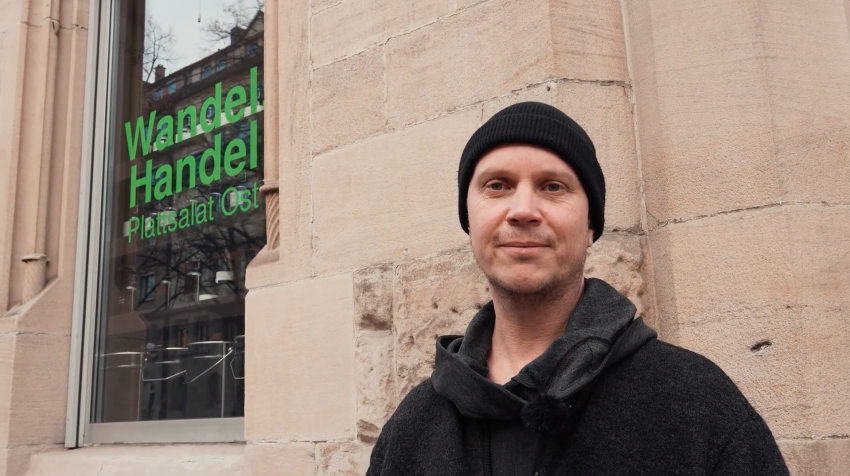
In Stuttgart East, there is an unpackaged goods store that wants to be more than just an environmentally friendly supermarket. “Wandel.Handel” is a members' store, café, and educational venue all in one. People can shop here, spend time, meet others, and get involved. The principle of solidarity forms the basis: membership fees, products at cost price, and a café with the motto “pay what you think it's worth.” The store is part of the “plattsalat e.V.” association, which was founded in Stuttgart in 1998. The original idea was to promote regional organic farming, create fair trading conditions for producers, and make high-quality organic products accessible to people on low incomes. At the same time, “plattsalat e.V.” wanted to try out a different way of doing business. Self-determined, not primarily driven by sales, and beyond classic profit logic. Several stores have emerged from it, which are now organized as independent entrepreneurial companies. Special statutes ensure that members retain co-determination rights here as well. In this way, “plattsalat e.V.” combines entrepreneurial stability with democratic control. “Wandel.Handel” expands the original principle of the umbrella association to focus not only on fair supply but also on providing the neighborhood with a social meeting place.
An organic grocery store as a “third place”?
In sociology, so-called third places are places that play a role in a person's life alongside their home and workplace. Sociologist Annette Plankensteiner, professor of social work and sociology at DHBW Stuttgart, describes these as places that are open in terms of subject matter. “You go there without knowing who you will meet or what topics you will discuss,” she explains. This openness distinguishes third places from traditional meeting places, which are often tied to specific groups or purposes. Plankensteiner emphasizes that such places are central to social cohesion: values, understanding, and democratic culture arise through real encounters. “Only through physical encounters can attitudes and mindsets truly change,” adds the sociologist.
Wandel.Handel offers space for social encounters. But does it function as a “third place,” i.e., an open space for social mixing, or rather as a meeting place for a specific social group? We met Fabian Stuhlinger, one of the initiators of “Wandel.Handel,” in his store and talked to him about the concept. Watch the video to see how he sees the store and what the neighborhood thinks about it.
“Wandel.Handel” shows how retail can be socially responsible. Fair prices, open doors, co-determination instead of traditional ownership. What emerges is not an individual ideal project, but a model with social impact.
Sociologist Annette Plankensteiner emphasizes that traditional cafés and organic shops are mainly used by the well-off middle classes. “These places are not accessible to people living in poverty. The barriers are far too high,” adds the professor. The barriers she refers to are primarily prices, atmosphere, and expectations. Solidarity-based pricing models help: those who have more money pay more, those who have less pay less or nothing. “This is a very good idea because the barrier is lower and you don't have to come out,” Plankensteiner affirms. No one has to explain or justify themselves. Participation becomes possible without stigmatization. From a sociological point of view, this is very poverty-sensitive because social differences are not made visible but are carried along in everyday life. People from different groups can come together. An organic grocery store as a third place.
Belonging through encounter
Such places are also particularly important from a neighborhood perspective. Neighborhood planner Udine Thiel from the city of Stuttgart emphasizes that vacant buildings and purely functional shopping streets weaken social life. Places that are open and facilitate encounters counteract this. They enliven neighborhoods, create a pleasant atmosphere, and bring people together. “This feeling of belonging, of having arrived – that comes from encounter and communication,” explains the studied psychologist.
Consumption as an opportunity for cohesion
Third places such as “Wandel.Handel” show how shops in the city can be conceived differently: not only as places of consumption, but also as social spaces. They do not solve major social problems, but they start exactly where cohesion arises: in everyday life, in conversation, in togetherness. "Wandel.Handel" is therefore more than just a shop. It is an example of what social change can look like in concrete terms. Awareness, communication, and participation as the basis for a healthy community.
More stories on how to make our society future-proof can be found in this section.























Mehr von edit