Bikes vs. Cars: Stuttgart between Tradition and Change




CDU politician and city councillor Leonard Rzymann is responsible for urban development and a member of the mobility subcommittee. In the interview he talks about Stuttgart’s ambitions to become more bike-friendly and why the city is taking a different path than Tübingen.
In Stuttgart, Zweirat, the ADFC and Radentscheid are campaigning for a more bicycle-friendly city. They criticise that more needs to be done. Would you say that the state capital offers good infrastructure for cyclists?
I would say that, compared to many other large cities, there is still room for improvement in Stuttgart. On the other hand, the topography challenges us, especially compared to cities like Munich, which have more space, wider streets and no steep hills. It's much harder to achieve equal rights for pedestrians, cyclists, public transport and motorists here.
That's just a huge problem in this city. At the same time, we've made significant progress over the last ten years, with new cycle lanes and cycle routes. So we are moving in the right direction towards a more bicycle-friendly city.
Can you explain the challenges in more detail, what makes it so difficult in Stuttgart right now, especially in comparison to Tübingen or Freiburg?
Compared to Tübingen and Freiburg, Stuttgart is simply used differently. We have a lot of students, but we also have a lot of business traffic and a much larger city centre that attracts a lot of people. In addition, Stuttgart has no bypass to the north-east, which means that transit traffic also passes through the city. A city ring like in other large cities would significantly improve the traffic situation and create additional space for cycling and public transport.
Does that mean bicycle traffic should not restrict car traffic? In Tübingen, bicycles are given priority in some places. Isn't that conceivable in Stuttgart?
Our approach is to find solutions that take all traffic participants into account and do not favour one group over another. Bicycle lanes can work well where there are good alternatives to car traffic, such as on Tübinger Straße with Hauptstätter Straße. However, it is not easy to transfer comprehensive bicycle prioritisation to other areas. It is the task of politicians to balance the various interests and not to stir up hostility between car and bicycle traffic, but to find practicable compromises.
According to urban planning, Tübingen has invested around 79 euros per person per year in recent years. Even though there are significant differences, why are the differences so significant?
Yes, it is true. Stuttgart spends less money per person on cycling than Tübingen. We have different priorities. For us, it is crucial that public transport remains reliable and that no existing connections are cancelled. We believe it is wrong to reduce bus routes or increase the frequency of services, as has been done in some cases in Tübingen.
At the same time, we are continuing to invest in cycling without weakening existing public transport services. Our approach is to expand both areas – public transport and cycling – even if this means that progress in both areas is only moderate.
As a party that advocates for the preservation of car traffic, what is the CDU's position on expanding cycling infrastructure?
The CDU is often accused of only supporting cars, but that is not true. We have supported many main cycle routes in principle. We take a critical stance where cycle projects would result in the loss of a large number of parking spaces or significantly increase traffic congestion. That is why we often advocate pragmatic solutions, such as well-marked protective lanes for cyclists, which increase safety without removing entire lanes.
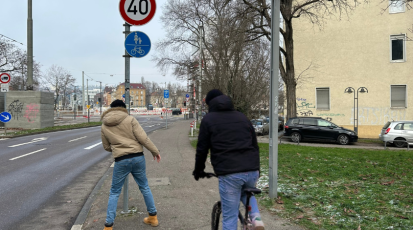
One example is the Schwabtunnel. There, large, colour-coded pictograms, better signage and a no-overtaking rule have demonstrably reduced the number of accidents. Speed reductions can also help to avoid dangerous overtaking situations. This shows that even small, quickly implementable measures can often bring about a noticeable improvement for cyclists.
The video illustrates the problems in the Schwabtunnel and contrasts Stuttgart’s approach with Tübingen.
With Mercedes and Porsche, Stuttgart is considered a car city. Can anything change in terms of a significant reduction in car traffic?
I do think that something will change in Stuttgart, even as a car city. Road space is limited, and we can hardly create additional space, so car traffic will decline in the future. Our biggest task is to create a service that gets people from A to B just as quickly and reliably as by car. In Stuttgart, I see this mainly as a role for public transport, which can also be used by people with reduced mobility. We have already made good progress in this area, especially in the city centre.
If car traffic takes up less space in the long term, we can also do more for pedestrians and cyclists. However, this will be more of a medium-term development, as there will always be people who depend on their cars. The key is to have a mix of all modes of transport that is so attractive that many people voluntarily choose not to use their cars.
Auch interessant
How do you see the traffic situation in Stuttgart in ten years time?
To be honest, many of the major changes, such as the redesign of central traffic axes or the city centre, are long-term projects, some of which will continue until 2045. We will see progress in ten years, but I expect the really big changes to happen in 20 years.
By relocating the Cityring, creating traffic-calmed areas around the main railway station and increasing the amount of greenery, we will significantly enhance the city centre. At the same time, the mix of transport modes will change, with more public transport, more cycling and more sharing options. But I also want to make it very clear that, in my opinion, anyone who wants to drive their own car in Stuttgart in 20 years' time should have the freedom to do so.
We won't be able to put cycle lanes on every street, but we need to keep making progress on the important main and through roads. Overall, I don't think Stuttgart is an unsafe city for cyclists today, even though there is obviously still room for improvement.
More stories on how to make our society future-proof can be found in this section.













Mehr von edit
Klimaneutral dank Bus und Bahn: Was für die Verkehrswende nötig ist